. Christine Burgin Gallery
projects and publicationsexhibition historycontact


Projects & Publications:

Zoe Beloff
Anne Chu
Harrell Fletcher
Hamish Fulton
Rodney Graham
Ricky Jay
Paul Lincoln
Allan McCollum & Matt Mullican
Matt Mullican
Max Neuhaus
Maria Nordman
Allen Ruppersberg
Michael Smith
Robert Walser

. Projects & Publications: Robert Walser

walser_microscripts.jpg

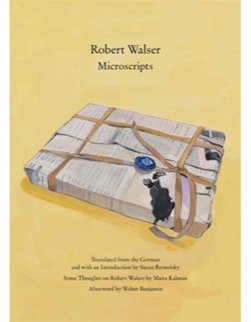
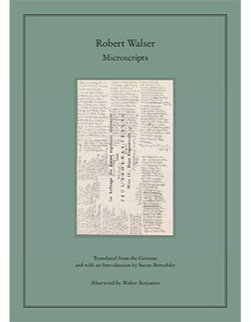
Robert Walser: Microscripts
Co-published by Christine Burgin and New Directions
Translated by Susan Bernofsky
Afterword by Walter Benjamin
Bilingual
160 pages with 28 color and 28 black and white illustrations
press release

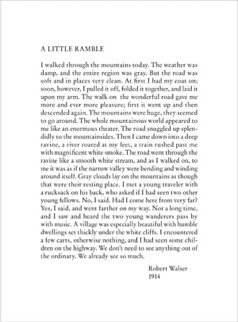
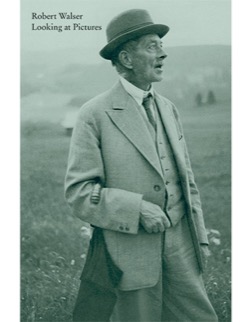
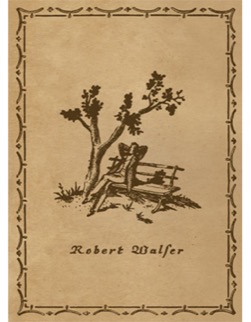
Born in Switzerland in 1878, Robert Walser worked as a bank clerk, a butler in a castle and an inventor's assistant while beginning what was to become a prodigious literary career. Between 1899 and his forced hospitalization in 1933 with a now much-disputed diagnosis of schizophrenia, Walser produced as many as seven novels and more than a thousand short stories and prose pieces. Though he enjoyed limited popular success during his lifetime, his contemporary admirers included Franz Kafka, Hermann Hesse, Robert Musil and Walter Benjamin. Today he is acknowledged as one of the most important and original literary voices of the twentieth century, his work the subject of essays by W.G. Sebald, J.M. Coetzee, William Gass and Susan Sontag. Describing his own work, Walser wrote: "My prose pieces are, to my mind, nothing more nor less than parts of a long, plotless, realistic story. For me, the sketches I produce now and then are shortish or longish chapters of a novel. The novel I am writing is always the same one, and it might be described as a variously sliced-up or torn-apart book of myself." In the latter years of his career, Walser struggled with a paralyzing writer's cramp that he combated by composing his texts in a miniscule pencil script written on small slips of paper that he carefully cut to size. This handwriting was so small that his guardian Carl Seelig mistook it for a sort of secret code. After his death in 1956 while out on a solitary walk, a collection of these papers were found among his belongings and preserved, but many years passed before they were transcribed and published.

Train Station (II)
Translated by Susan Bernofsky
From Robert Walser: Microscripts

One of the cleverest and most practical technological advances brought forth by the modern age is, in my opinion, the train station. Daily, hourly, trains rush either into or out of it, bearing persons of all ages and characters and of every profession off into the distance or else whisking them back home. What a life pageant is offered by this entity I am reporting on here with pleasure, though also without describing it all too exhaustively, as I am not an expert. I hope I am justified in observing it instead from a more general, accessible angle. The very picture the station presents, with all its comings and goings, can be described as highly agreeable, and to this must be added all the particularly refreshing and delightful sounds—he shouts, people talking, the rolling of wheels, and the reverberation of hurrying footsteps. Here a little lady is selling newspapers, and over there packages and small valises are being checked at the baggage counter for such and such a length of time. Amid the graceful clinking of useful money, train tickets are being requested and dispensed. A person about to set off on a journey quickly partakes of a sausage or plate of soup in the restaurant to fortify himself. In the spacious waiting rooms, male and female possessors of wanderlust cool their heels, some with a pleasure-filled jaunt before them, others pursuing serious business objectives and mercantile or commercial plans aimed at preserving their subsistence. Books are on display and for sale at a kiosk, including merely entertaining or suspenseful volumes and high-quality reading material. You need only reach out your hand for culture and pay the specified price. Elsewhere you encounter fruits such as apples, pears, cherries and bananas. Posters inform you of the interesting sights to be seen all over the world, for example an ancient city, quays bearing palace hotels, a mountain peak, an imposing cathedral, or a palm-studded landscape with pyramids. All manner of things both known and unknown are parading by. I myself am sometimes well-known, sometimes a stranger. Often entire associations go marching respect-inducingly through the main hall, a space that exemplifies the Machine Age and embodies something international. It's almost romantic to think that in all these countries, be it in the sunlit daytime or at night, trains are indefatigably crossing back and forth. What a far-reaching network of civilization and culture this implies. Organizations that have been created and institutions that have been called into existence cannot simply be shrugged off. Everything I achieve and accomplish brings with it obligations. My activity is superior to me. It's lovely when a parting takes place at a train station or else a reunion transpires and occurs.